13. Quandarianism

and lovely drizzle, youthful jubilation, eschewing prostitution, the humiliation of arms dealers, and the uncertainty of inanimate objects
(Note for those who haven’t read earlier tales: ‘AF’ is an Imaginary Friend and irritant who lives in my brain. ‘Richard’ is a cat. But I have to tell you, my darling Dickson is no longer a cat in the world. But I will write of him as if he were here, and we will still converse even though I will never again see his clever little triangular face or stroke his majestic coat of many stripes.)
Richard Dickson, looking entirely stately, presides like a figurehead at the prow of my desk.
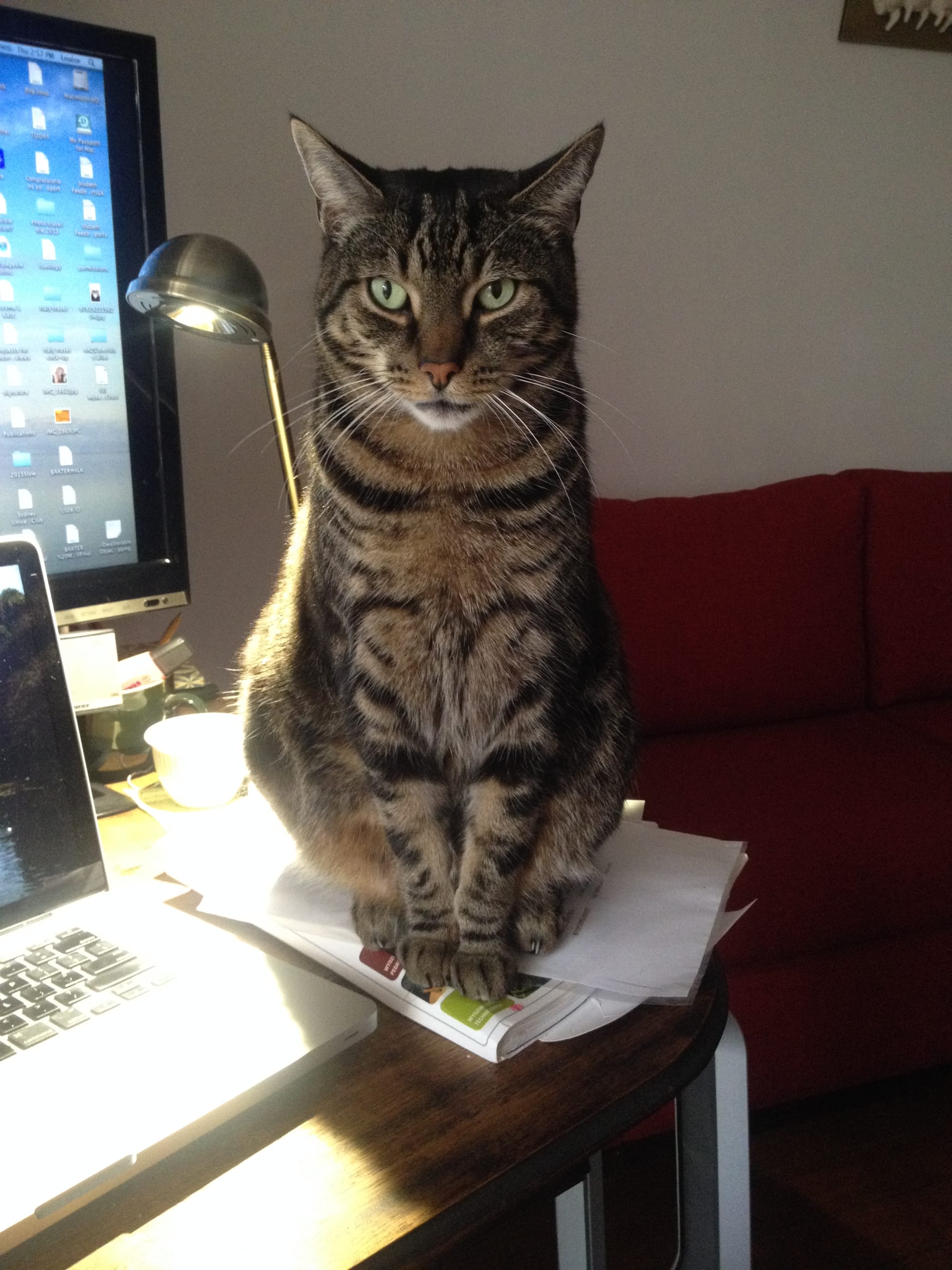
Desks don’t have prows, AF tells me.
They do when there’s a cat at the helm. A cat who is peering into the oncoming darkness as we surge forward into this night without stars, almost black but not quite because of the yellowish fuzzy-edged light leakage from the distant Big Smoke. The air is salt-and-eucalypt scented, mixed with petrol exhaust because it’d been a big tourist day with lots of cars plus a cavalcade of motorbikes that I always enjoy.
On this evening, no dolphins frolic in the wake of our metaphorical ship. There is no luminescence sparkling among the waves. The atmosphere is close, almost no breeze at all, and dry lightning is flashing with barely-controlled antipathy in the not-so-far distance.
What a lot of equivocation, says AF.
What do you mean?
You start out with some lively description, then we find the black is yellowish, that’s there’s almost no breeze. And dolphins that don’t frolic? Lightning barely controlled? I ask you! Despite being opinionated, you’re actually a quandarian. Just worked it out! he crows exultantly. A quandarian. Ha.
I have a fair idea of what he means by that, because background thoughtness to the things AF tells me directly inevitably leak out of the part of my brain he’s occupying at the time and seep into our common territory. And although I’m irritated at being told what I am—I can say without any equivocation that I hate that—I find I’m keen to know more particularly what he means, so I ask him to extrapolate.
You know, You! Like a contrarian but without the certainty.
I huff: So I’m confrontational but lack conviction? You reckon?
I reckon.
AF, I can just feel you getting all puffed up and glossy over that so-clever new word of yours, but I don’t think you’ve thought it out that carefully, at least as applying to me, because if you had …
I have! A lot.
You’d see it’s bloody cheeky of you, given how you’re always trying to talk me down off my high horse when you reckon I’m getting opinionated and obstreperous. So you’re not actually making a lot of sense.
A quandarian can make a loud assertion, but still feel doubt. You don’t have to tell everyone about every doubt. You know, you really ought to be more respectful of us figments and fabrications. Who else do you know would put up with your saying one thing then flinching at yourself like a skittish cat—sorry, Puss, I mean Dick—and flinching at me too when I’m only trying to help. It’s a useful word. Quandarian. I like it—you, I can take or leave.
But you have to take it, because you can’t leave, you figment.
But AF has actually taken the latter option. He’s gone. Vamoosed. I know it’s temporary, but I do feel bad now. I know how sensitive he is about being bodiless and I could feel the residue of his upset, all nubbly and scratchy with hurt and irritation—it feels like having eczema of the brain. And now, the not-quite-black sky glowers beyond the big glass door, and the lightning flickers moodily. When AF departs like that after a disagreement, the gap he leaves behind is bleak and I find myself in a nothing sort of place between now and next. An airless liminal gap above an abysmal ocean. Nothing moves in the windless sky. No birds cry. No waves lap.
I go out onto the balcony to cogitate, but the real tangible visible smellable night air to which poor AF has no access is still as almost-black, pimpled with hurtful stars. And my reflections, which usually configure themselves like nice little worry beads that grow in form and lustre as I contemplate something, now feel all shrivelled and sad.
The depleted state of my beads may, I think, also have to with my being hungry.
I walk down the veranda to the kitchen, get a bowl from the cupboard, fill it with leaves and chop in a cold potato from the fridge and a fistful of herbs from the veranda pots, grate cheese and add it and half a tin of tuna, the sort that says ‘dolphin-friendly’, but really, who knows? Garlic. Dress the lot with mustardy mayonnaise, something I developed a taste for when I lived in England.
That hyped-up mayonnaise; I’d have it on toast; make it into sandwiches with tinned beetroot; mix it with a tin of sweet corn, my staples along with Weet-Bix and the odd doner kebab. I was very poor but as I’d just turned twenty-one (in a plane somewhere over Turkey en route from Aus) and I’d got myself overseas, I was in a state of perpetual exhilaration—even the sodden walls of the squalid flat where I first lived were exciting because I was overseas!!! I loved the drizzle! The louring grey skies were bliss! Bad-tempered strangers on the street—yay, foreign cranky person, oh what a splendiferous novelty! Everything sent me into ecstasies of love. Back in Australia I’d saved up my cannery money along with the rent I didn’t pay as I was living in a tent at the time, and now I was in heaven aka Brixton. Much dissoluteness followed over the next year or two, though, I remember …
Although I’m caught up in reminiscence, immobile by the kitchen counter holding the squeezy mayonnaise bottle, I notice that Richard, who must’ve smelt the tuna and had probably been there since The Opening of The Tin, is figure-eighting around my legs to remind me that we’re bound together in the common interest of each other. So I go out onto the dark veranda with my bowl, switching on the fairy lights as I go so that everything’s pretty. Dick and I sit together on the couch, me with my big bowl, the cat with his little tin of fish.
Dick takes a break from his dinner and says, About AF’s theory...
Hmmm?
When do you think the quandarianism set in, Person? He then adds tactfully, That is, if it set in, of course...
I remember that back then in London and elsewhere I’d been fearless, stupid, brave, fervent, idiotic in different measures at different times.
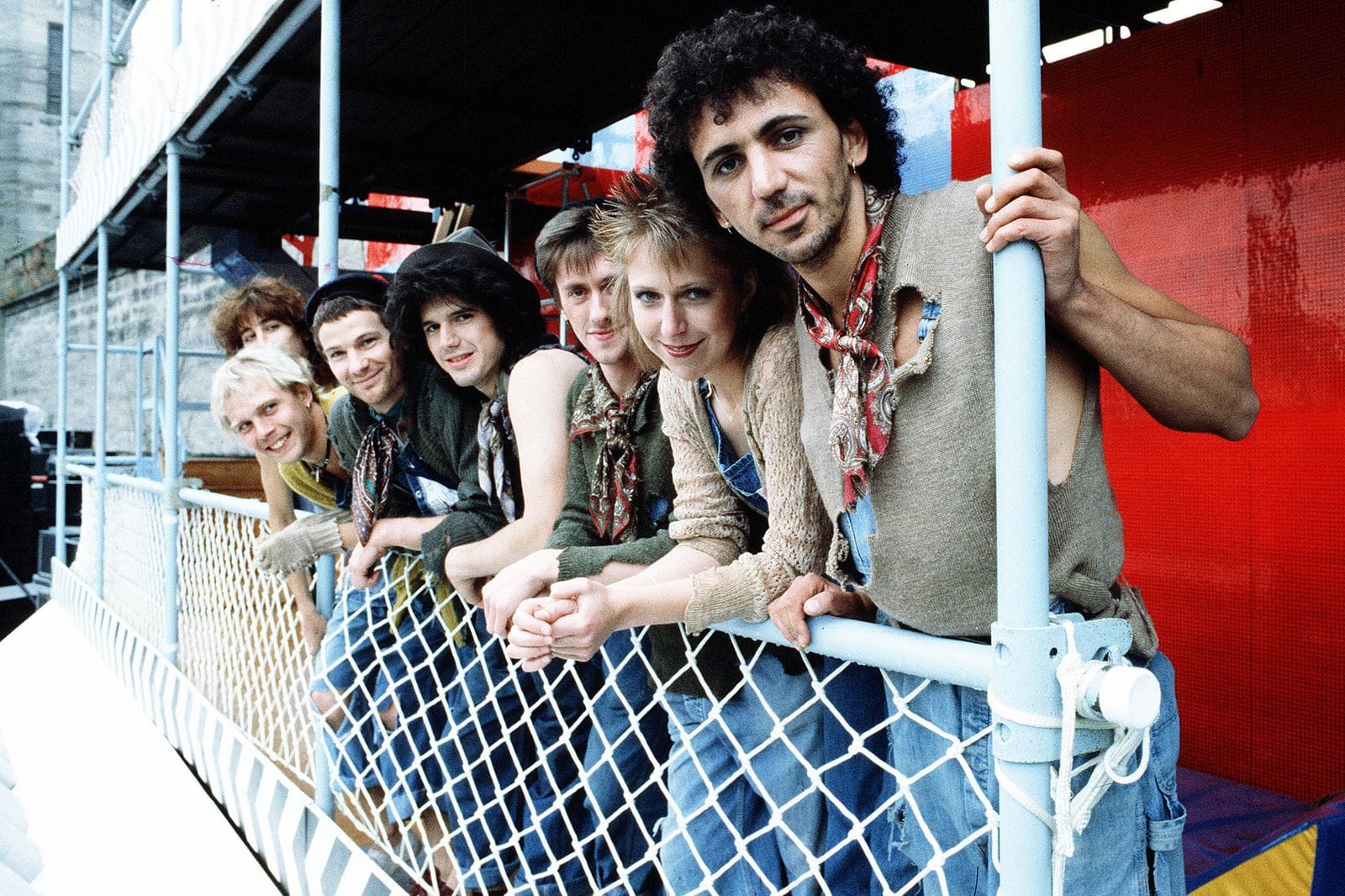
In London I had no trouble finding work in a succession of restaurants and bars, serving meals or pulling beers with those heavy, complicated brass English levers, and once also as a topless hostess in a Mayfair nightclub, where I developed a sharp taste for amphetamines for as long as that job lasted (and which ended one night when I almost died from overuse of said substance) and which I bought from a neighbour who made it, in the squat in Peckham where I was living by then with my one-time beau, a lovely hairdresser called Victor, from Glasgow, who I remember dancing so joyfully to Dexy’s Midnight Runners
and whom I carelessly lost somewhere.
Without exception, I was fired from each those jobs (from a tourist restaurant in Piccadilly styled as medieval Olde England, for accidentally leading the elegantly costumed blind ‘town crier’ into a glass wall—I didn’t have my glasses on—but happily neither of us was injured; then from a very stylish French restaurant for either incompetence or failing to bed the proprietor; from a Thames tour boat for scolding a punter who’d thrown his bottle into the river—insufferably moralistic even then; from a very poorly paid job in Putney for being ‘a subversive influence on the other staff members’—can no longer remember what subversion I’d committed—and from the Mayfair place for failing to realise I was supposed to be a sex worker, as I had no intention of shagging the clientele.
But my rudest exit was from a very smart restaurant near St Paul’s. Like this: dim light, a round table of clearly very affluent middle-aged men. Much expensive wine. Men talking business. What business? Arms dealing. Dessert. A ‘gentleman’ pinched my bottom. Coffee.
With careful deliberation I poured a scalding cup of it into the lap of the offender.
A scream.
My heart sang.
So then I poured the cream into his lap to cool things off for him down there. Ha!
I wrote a piece of charming piece of doggerel about it later:
Scores of boors with grinning jaws
Bring to the fore their knives and forks.
A spot of sauce on trim moustache
One stoops to pinch a waitress arse.
Her soul says, Damn you, go to hell
Her mouth says, Please sir, cream as well?
It went on, but never mind.
A year or so later I hitched to Greece from East Berlin (yes—that’s how old I am) and thence to the Middle East, to Egypt, Palestine, Israel. There was no need for mustardy mayonnaise in any of those places.
I finish my dinner. Richard is sitting next to me washing his face in that madly cute way cats have. I thumb my imaginary worry beads and feel them plumping up a little as an interesting thought occurs to me: the Quandary Zone has classical origins. The Quandary, I realise like dawn breaking over the bombsite of my mind, is like Plato’s aporia, that mental place you get to when you’re stumped.
Plato’s Emporia? queries Richard, looking up from his bath. Did Plato set up an ancient Greek department store as well a school of philosophy?
Aporia, Dick. I briefly explain to the cat about being stumped, at an impasse, which is actually the in-between ground where fresh ideas can germinate.
Person, I’m struggling with impasses as creative zones. But I do appreciate the problem of impasses in themselves. I’ve experienced a few when faced with a crack in a wall into which a skink has slipped—evasive things sneaking into cracks are discombobulating. Do you think experiencing such slippages could be a function of slowing down, of age? he asks. And also, more generalised feelings of uncertainty?
Older people being less sure of themselves than younger ones? Oh yes. Indubitably, Dick. I was very certain when I was younger, and almost always wrong.
Thought so. Same with cats.
But look—insecurity, quandarity, all that—it’s not exclusively for older creatures, AF butts in, causing the fairy lights to flicker. Seemingly he’d recovered enough to return for round two. Figments also get it, he pronounces—And inanimate objects as well. They understand uncertainty all too well as they also have to bear life’s exigencies in many and varied ways. Have you never appreciated the anxiety of salt-shakers, for instance—poor things who may not understand their purpose in life, thinking, Oh god, when will they next have me quaking and spattering all my precious contents over their dinner? Or the grievous insecurity of tin openers, who know full well that their moving parts won’t remain reliable forever, especially since they’ve already become largely redundant due to the ubiquity of the ring-pull? Or the self-doubt experienced by a delicately constructed silversmith’s planishing hammer when confined to a shelf heavy with sledgehammers and brick hammers and club hammers or, worse, the misnamed beetle mallet, also known as the ‘commander’?
Dick and I look at each other nonplussed. Anxious gadgets? Tools in a quandary? Suffering from uncertainty, self-doubt?
I want to say something about ‘inanimate’ meaning unalive, but now I have my doubts.